
No products in the cart.

 25Sep
25SepHow to Choose the Right Caster Wheel for Your Equipment
Caster wheels may be modest, nevertheless, they bring a big change to the way equipment functions. Casters offer mobility, safety and efficiency to hospital beds, industrial carts, office chairs and retail displays. The improper caster, however, may harm floors, wear out fast or even cause occupational hazards.
This guide covers the definition of caster wheels, their uses, advantages and disadvantages, types, sizes and uses in industry and lastly demonstrates to you how to choose the appropriate caster wheel to use.
What Is a Caster Wheel?
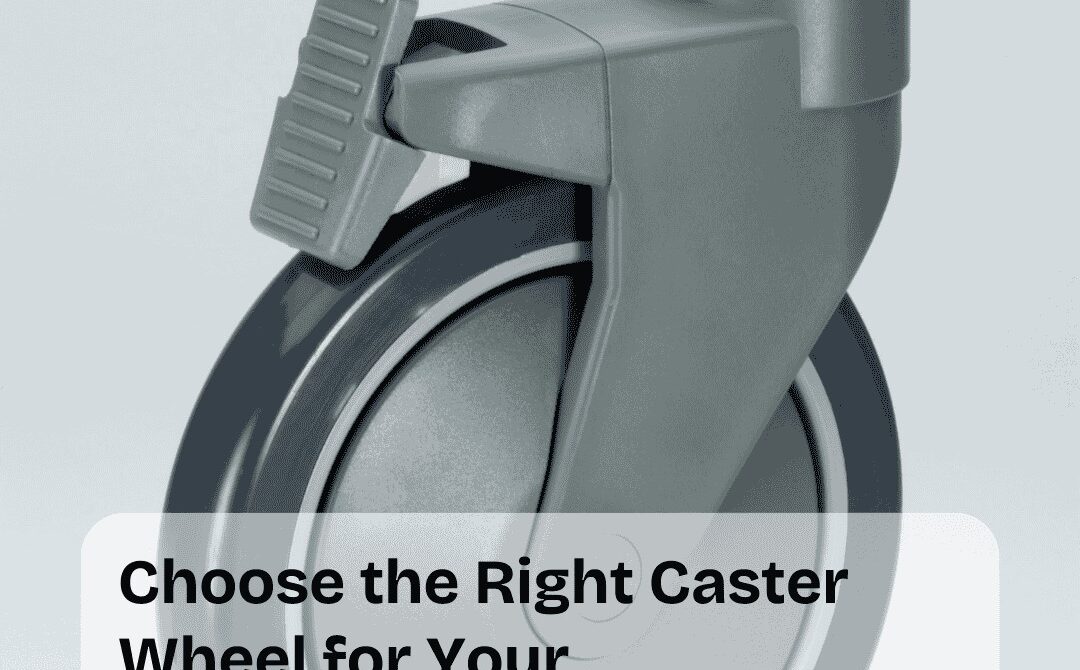
A leading caster wheel is a moving element attached to the bottom side of equipment or furniture, which allows it to move easily. Casters are flexible and manoeuvrable as opposed to simple fixed wheels, being either rigid (straight-line movement) or swivel (360° rotation).
Each caster typically has three main parts:
- The wheel (rubber, nylon, polyurethane, steel, or pneumatic).
- The mounting system (plate or stem).
- A bearing/swivel mechanism that determines mobility.
In essence, caster wheels are the “shoes” of equipment the right pair makes movement easy, the wrong pair causes strain and inefficiency.
Applications of Caster Wheels
Caster wheels are found in nearly every sector:
- Healthcare: Hospital beds, trolleys, diagnostic equipment.
- Warehousing & Logistics: Heavy-duty carts and material-handling equipment.
- Offices: Chairs, cabinets, and mobile workstations.
- Retail & Hospitality: Display stands, service carts, luggage trolleys.
- Construction: Outdoor machinery requiring pneumatic wheels.
- Homes: Furniture, toolboxes, and kitchen islands.
Their role is universal — wherever equipment needs safe and reliable mobility, caster wheels are essential.
Pros and Cons of Caster Wheels
Pros
- Improve mobility of heavy or awkward equipment.
- Reduce strain on workers and improve safety.
- Available in multiple materials for different surfaces.
- Increase efficiency in industrial and commercial settings.
Cons
- Wrong material can scratch or damage floors.
- Overloading reduces lifespan or causes failure.
- Cheap casters may generate noise or vibration.
- Require periodic inspection and maintenance.
Types of Caster Wheels
Choosing the right caster begins with knowing the types available:
- Swivel Casters – Rotate 360° for easy maneuvering in tight spaces.
- Rigid Casters – Roll only forward/backward, offering stability for heavy loads.
- Locking Casters – Include brakes or swivel locks for safety.
- Pneumatic Casters – Air-filled, ideal for rough or outdoor terrain.
- Heavy-Duty Casters – Engineered for industrial machinery and high loads.
- Low-Profile Casters – Compact, common in electronics and furniture.
Dimensions and Sizing
Caster size directly affects performance.
- Wheel Diameter: Larger wheels roll more easily over obstacles and support higher loads.
- Tread Width: Wider treads spread weight and protect flooring.
- Mounting Height: Determines equipment stability and clearance.
- Load Rating: Maximum capacity per wheel.
Example: A cart weighing 400 kg with 4 casters needs at least 100 kg per wheel. Add a 25–30% safety margin, and you should select casters rated for 125–130 kg each.
Industrial Uses of Caster Wheels
Different industries require specialized caster solutions:
- Healthcare – Quiet, non-marking casters ensure smooth movement.
- Logistics – Polyurethane casters handle constant wear on concrete floors.
- Food Service – Stainless casters resist water and cleaning chemicals.
- Construction – Pneumatic casters withstand rough outdoor terrain.
- Labs & Electronics – Anti-static casters prevent damage to sensitive equipment.
How to Choose the Right Caster Wheel
To choose the right caster wheels, you need to evaluate three main factors: the total load capacity, the floor surface, and the working environment.
Load determines how strong the wheel should be, surface type decides whether soft or hard wheels perform better, and environmental conditions like heat, chemicals, or outdoor use require specialized wheel materials.
Now let’s bring it all together. When selecting casters, consider these factors:
- Weight Capacity
Calculate the total weight (equipment + load) and divide by the number of wheels. Always add a safety margin. - Flooring Surface
- Rubber for tile or wood.
- Polyurethane for concrete.
- Pneumatic for outdoor surfaces.
- Nylon/steel for heavy machinery.
- Caster Type
Swivel for maneuverability, rigid for straight-line stability. A mix of both works best in many setups. - Environmental Conditions
Wet areas require stainless steel; chemical exposure calls for nylon or polyurethane; cleanrooms need non-marking casters. - Wheel Dimensions
Larger diameters = smoother rolling. Wider treads = better floor protection. - Safety Features
Brakes, swivel locks, and directional locks improve control in industrial or medical settings.
How to Determine Caster Wheel Size?
Caster wheel size depends mainly on load, floor condition, and clearance height.
- For heavier loads, larger wheels are preferred.
- Rough or uneven floors also require bigger wheels to move smoothly.
- If the equipment has height limitations, you must choose a wheel size that fits within the allowed clearance.
- In general, light-duty equipment uses 3–5 inch wheels, while heavy-duty carts use 6–12 inch wheels.
How to Calculate Caster Wheel Load?
The load capacity of a caster wheel is calculated using this formula: (Total Weight of Equipment + Maximum Load) ÷ Number of Casters × Safety Factor (1.2–1.3).
For example, if a machine weighs 200 kg and carries 300 kg of load with four casters, the calculation will be (200 + 300) ÷ 4 × 1.25 = 156 kg. This means each caster should support at least 156 kg safely.
How to Measure Wheel Caster?
Measuring a caster involves a few specific steps:
- Measure the wheel diameter from edge to edge.
- Measure the tread width or thickness of the wheel.
- Measure the overall height from the floor to the top of the mounting plate.
- For plate casters, measure the center-to-center distance of bolt holes.
- For stem casters, measure both stem diameter and length.
Final Thoughts
Caster wheels may be small, but they play a critical role in the movement of equipment, its durability, and the overall safety of people. By understanding their characteristics, applications, advantages and disadvantages, types, and sizes, you can make an informed decision.
Choosing the right caster wheel improves mobility, protects flooring, extends the life of your equipment, and enhances workplace safety. It’s important to select quality casters that suit your environment and load requirements, whether for a warehouse, hospital, or office.
I highly recommend ISMAT Trading for reliable caster wheel solutions. Speak to our specialists today and receive expert advice tailored to your equipment needs.
Explore More Expert Insights
Discover high-performance seals, plastics, rubber products, gaskets, and building protection solutions for your next project.
- Polyurethane vs Rubber: Which Is Better for Your Business? – Best Material Choice for Industrial Performance
- Silicone vs Rubber: Understanding the Key Differences – Compare Durability, Flexibility & Use Cases
- Why Choose Engineering Plastics Over Metal Components? – Lightweight, Durable & Cost-Effective Solution
- The Pros and Cons of Rubber Flooring – Smart Guide to Rubber Flooring Benefits
- 5 Initiatives Transforming Manufacturing in UAE – Innovations Powering UAE’s Industrial Future


